Contours
VOLUME ONE • ISSUE 4 • CONTOURS
Form.
Aubade
Nicholas Rooney
Into the Open Wound of Machines
Mikkel Rohde Skovlunde
What I will do for warmth
Archana Dineshkumar Manhachery
(( Otherwordly ))
Liliana Del Vedova
Figure.
Spin Particles
Darcy Smith
In Conversation with Aiman
Aiman and Nicole Fan
I left my name at the start
Erin Rowlinson- Martin
Evidence
Peter Lilly
Fractures.
Warrior Clouds
Ulrica Hume
Fragments of Experience
Patrycja Loranc
self-portrait as fabrics
Emily Liu
Polyester Paganism
Abi Hubbard
Flight
Reyzl Grace
Editor’s Letter
Dear Reader,
In all beginnings already lie an end, the telos tethered to every inception of desire. We start things only to complete them, reaching past each precedent to excise and eclipse — only to find ourselves defined by our denouements, aspiring for the resolution of it all. Is it substance that matters, or is it form? Is essence any more essential than the shape it takes, or might configuration and matter co-create?
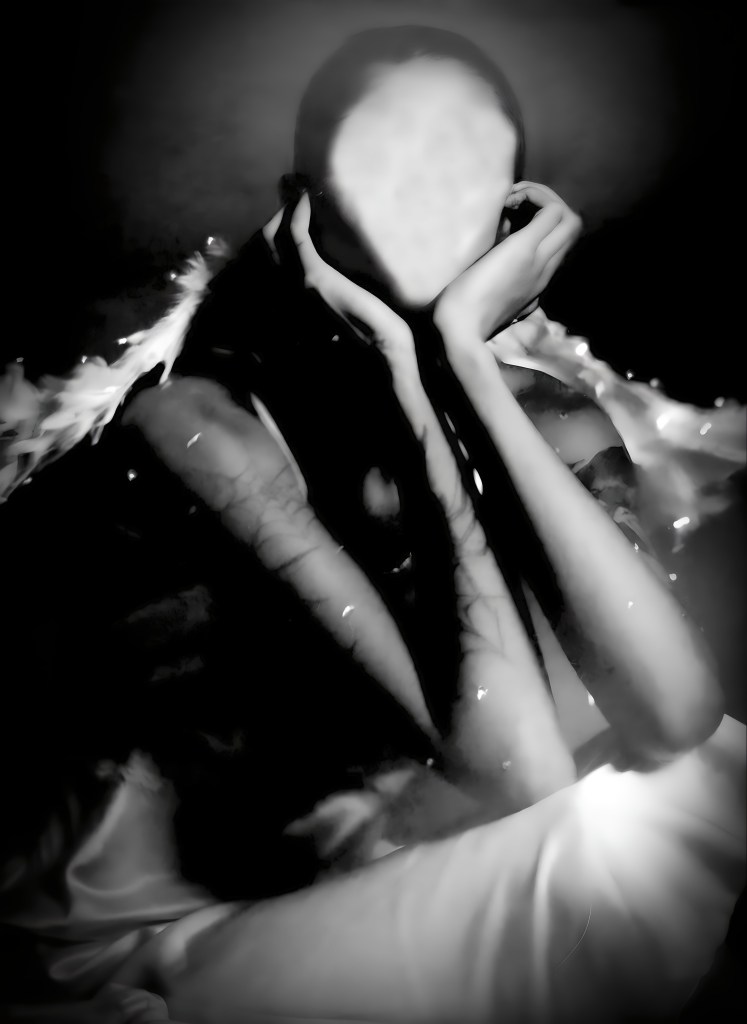
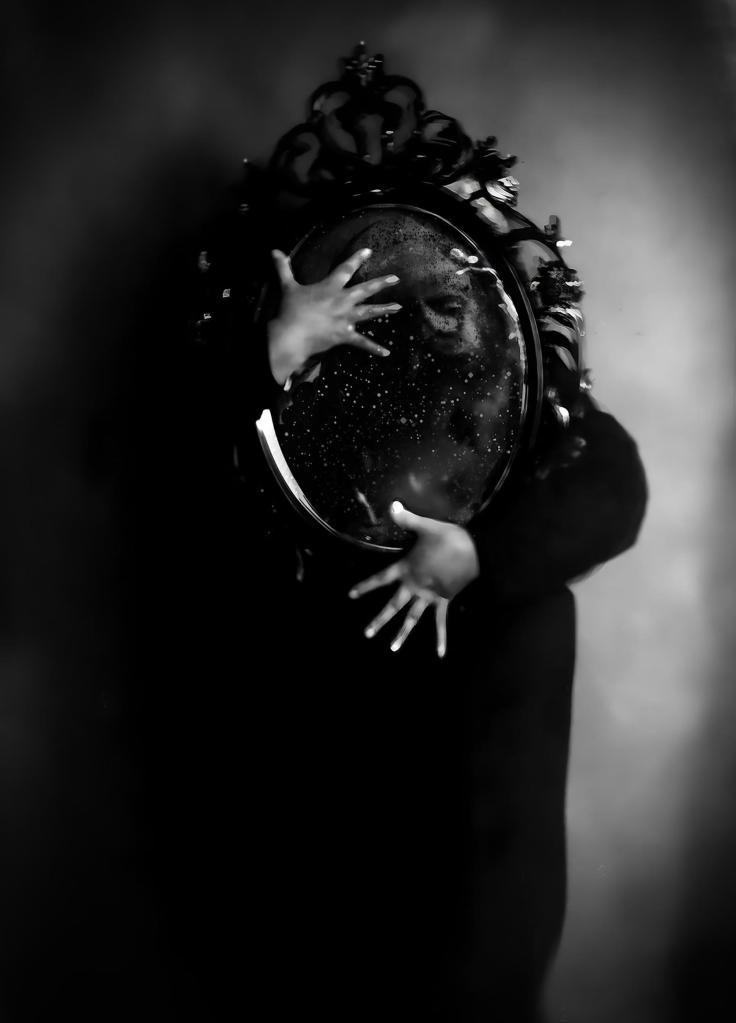
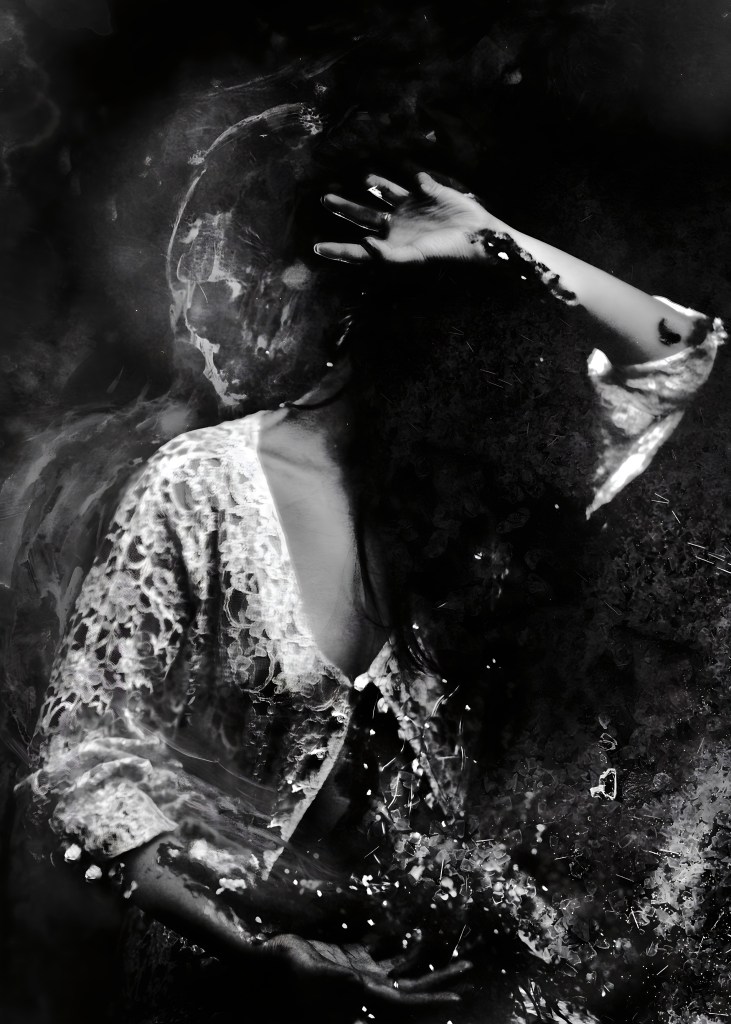
Taking that inquiry as its starting point, this issue centres around the idea of contours: limits that circumscribe by girding the boundless, but clarify by reifying the nebulous. We open with abstraction endeavouring to find form — with bodies ‘soaring through the / possibilities of flesh released from itself’ in Nicholas Rooney’s ‘Aubade’ while being weighed down by the physicality of the present. Then, capillaries dilate and expand, but are revealed as contrivances within contraptions in Mikkel Rodhe Skovlunde’s Into the Open Wound of Machines. Yet, the frontier between the human and nonhuman is tenuous for, as Archana Dineshkumar Manhachery puts it, ‘grit, fluid and fire […] can crush several borders’, rendering the inanimate into ‘the most human confines’. Indeed, objects can become totemic carriers of meaning: such is the case in Liliana Del Vedova’s (( Otherwordly )), which photographically traces psychic intricacies.
Even as form begins to crystallise, definition remains ever elusive, complicated by deeper considerations of the real and the illusory. We find what’s ‘impossible to break’ in Darcy Smith’s ‘Spin Particles’, only to realise that its strength comes from being ultimately ‘imperceptible’. We traverse Aiman’s vivid terrains, only to discover a topography that is hyperreal in its numinosity, with the earthly and spiritual coalescing to reveal that The Significance of it All is the Insignificance of it All. Signification continues being malleable in Erin Rowlinson-Martin’s ‘I left my name at the start’ — for having taken a name and ‘stretched its meaning’, nomenclature is dismantled for a spell. Perhaps, as Peter Lilly’s ‘Evidence’ attests, ‘The answer is to ask / For nothing’ — to rescind the intellectual query and instead dwell in the volatility of an existence that is ever in flux, ever collapsing space and time within ‘its / Perpetual explosion’.
Thus we continue in the aftermath of a blast — one that erases the contours of individuation and allows us to be anyone, anything, anywhere. Return to the ‘ancient place’ of mythic truth in Ulrica Hume’s ‘Warrior Clouds’, where the ‘hieroglyphics of the soul’ are being pieced together. Witness life chopped, cut, and cohered in Patrycja Loranc’s Fragments of Experience, before drifting into a ‘blurring world’ where Emily Liu depicts her ‘return / to mere outline’ in a ‘self-portrait as fabrics’. Dissolve all distinctions within Abi Hubbard’s Polyester Paganism, and find binaries melting by the ‘beautiful, alien, and transformative’ properties of slime mould. And then let yourself go — go anywhere, go everywhere, to ‘see things as they truly are’ in Reyzl Grace’s ‘Flight’.
Swooping in arcs across the cosmos, diving into the depths of this terrestrial sphere, we find both definition and liberation through our contours, those traces that simultaneously function as both closed boundaries and thresholds of possibility. For while all beginnings contain their ends, all ends have their embryonic entelechies; the depths of which run deep, the edges of which give shape to new forms.
Love,
Nicole
I.
Form
POETRY / NICHOLAS ROONEY
Aubade
Ley lines glimmer and extend across
the blind slat edges.
Light leaks into the room,
gilds the bookshelves and the wardrobe.

A radiator creaks. You stir, mutter,
then sink back into sleep,
taking more than your fair
share of the duvet with you.

The first fingers of the sun find
your face, inscrutable.
You are elsewhere, soaring through the
possibilities of flesh released from itself.

I lie and look for galaxies in the sunbeams,
strain to hear, in your breath, the
winds of other worlds.
VISUAL ART /
MIKKEL ROHDE SKOLVUNDE
Into the Open Wound of Machines

The human cylinders
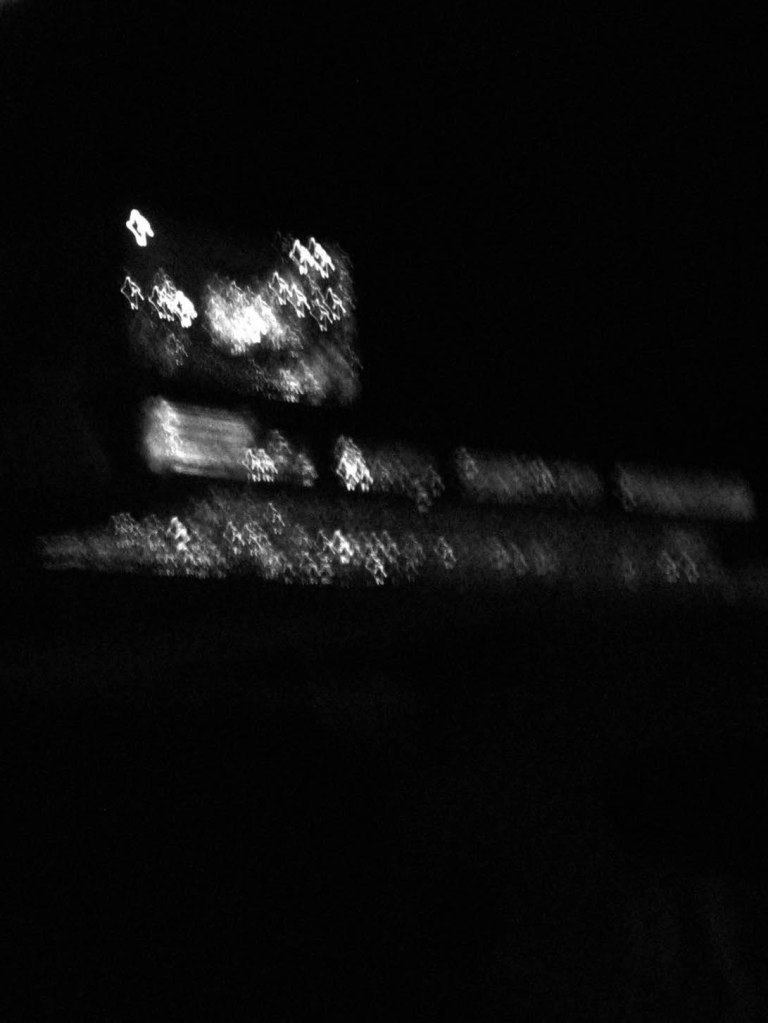
Revolving in the enervating dusk
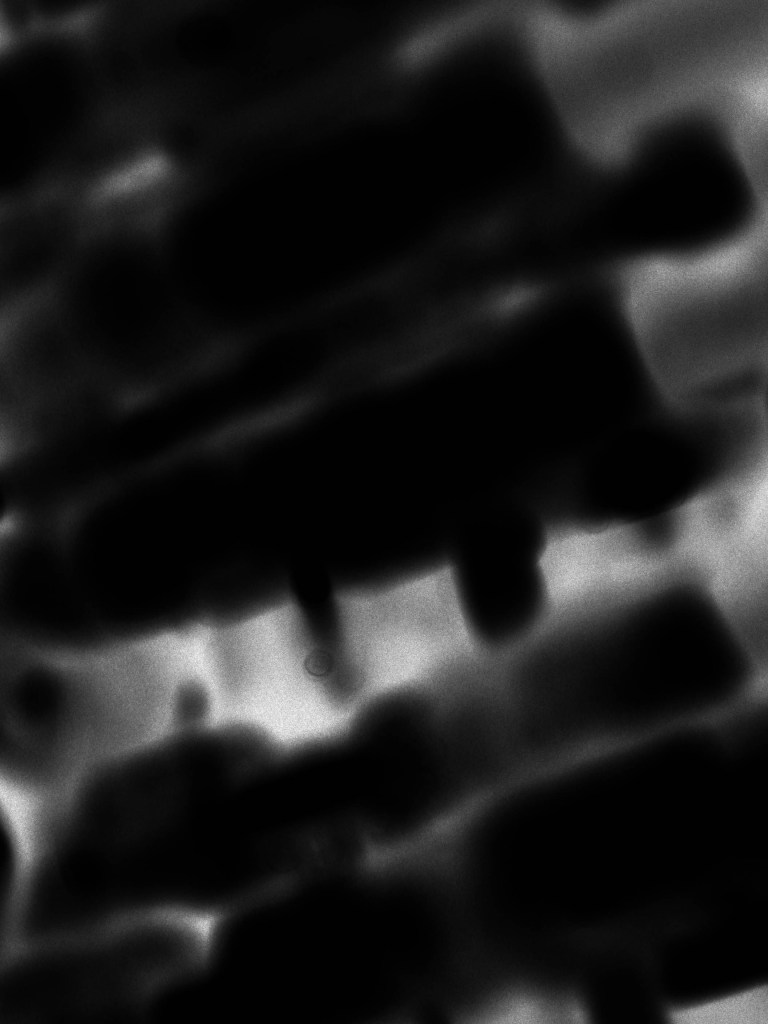
That wraps each closer in the mystery

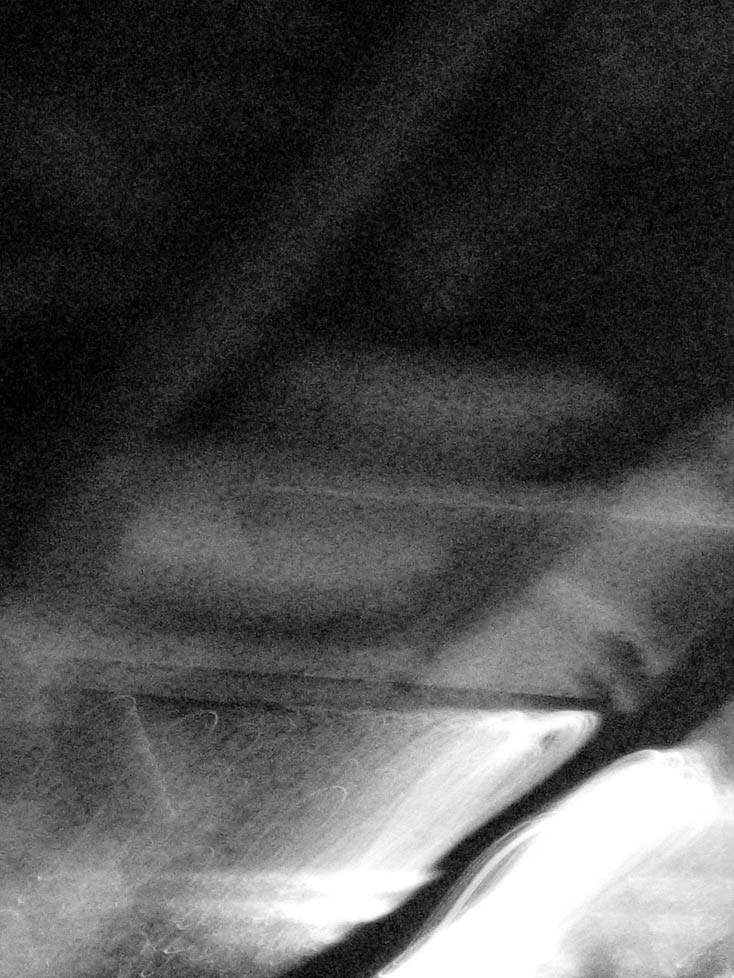
Of singularity
— Words from ‘Human Cylinders’ by Mina Loy
POETRY /
ARCHANA DINESHKUMAR MANHACHERY
What I will do for warmth
The walnuts peck their hammocks —
their skulls or shells, goodbye
and step away
to steep in the shadow
of a cinnamon bark.
I too am in a dry,
sweet-and-spicy daze,
and so are the vestiges of
a flaky plainness
coating the balmy core
of oats.
From the fridge
to the spice boards,
the ginger kitten’s fur
has been anointing
a layer of her kingdom.
I have a penchant for
volatilising it,
for being a human.
With grit, fluid and fire,
I crush several borders
for my evening snack.
Later, I will drape my legs
and a desk will unravel.
The curated bowl
will be the tumbler bathing
a cold desert — the most human confines,
for just one minute.
II.
Figure
POETRY / DARCY SMITH
Spin Particles
— Mass determines how much a particle resists changing its position when encountering a force.
Narrow
the night
curtains, the black-
outs I shut. Mom made me
learn to count
each breath.
Narrow under
bed springs,
coiled
like the smallest
possible particle,
like a quark or alveoli,
thinnest single-cell
walls.
She says,
This heat will quell; he’ll fall
asleep. When I find myself
in the back
hall closet, I inhale
gravity. Each capillary
carries me
like the lake upstate,
the one place
where exhalation
unfurls
his clenched
fist, taut jaw,
long bellow and flame.
In the linen closet,
I pull
the light cord, click —
dank blankets, darkness.
I’m imperceptible,
a hydrogen atom,
impossible to break.
INTERVIEW / AIMAN & NICOLE FAN
In Conversation with Aiman:
The Significance of it All is the Insignificance of it All
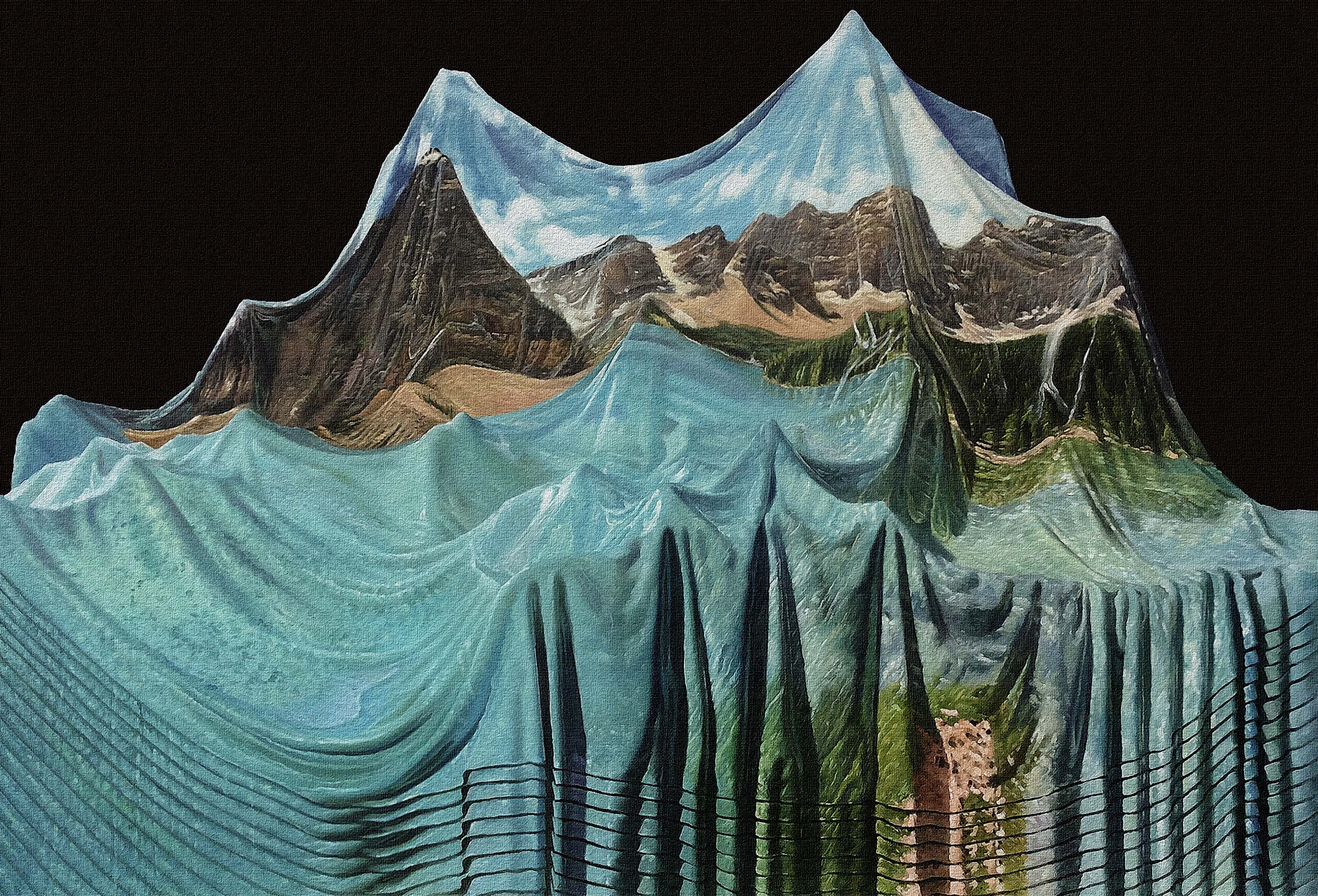
Canvassing vast bodies of water and wide stretches of land, Aiman’s art renders the beauty of this world with penetrating acuity and photorealistic precision. Of foliage and flesh, of liquid and life, there is no scarcity — yet, take a step back from the granularity of the grandeur, and the visible plane crinkles, creases, and collapses. The solid crumples into the fluid; the veil is pulled away: this is how the fabric of reality folds in upon itself, to reveal that The Significance of it All is the Insignificance of it All.
Premised on a Platonic allegory of epistemic doubt, Aiman’s series explores ‘the dynamics between that which is tangible — the world of perception — and that which is possible — the eternal realms that exist beyond’ — through the interplay of imitation and illusion. Oil on linen mimics only to mystify, its naturalistic figuration undercut by structural instability; yet, this very quality ‘creates new meaning, and gives us a glimpse of the very essence that connects us’. On the cusp of a new exhibition and a new chapter in his artistic career, Aiman opens up about the paradox of perception that informs The Significance, the philosophical principles that shape his work, and the unexpected comforts of facing the unknown.
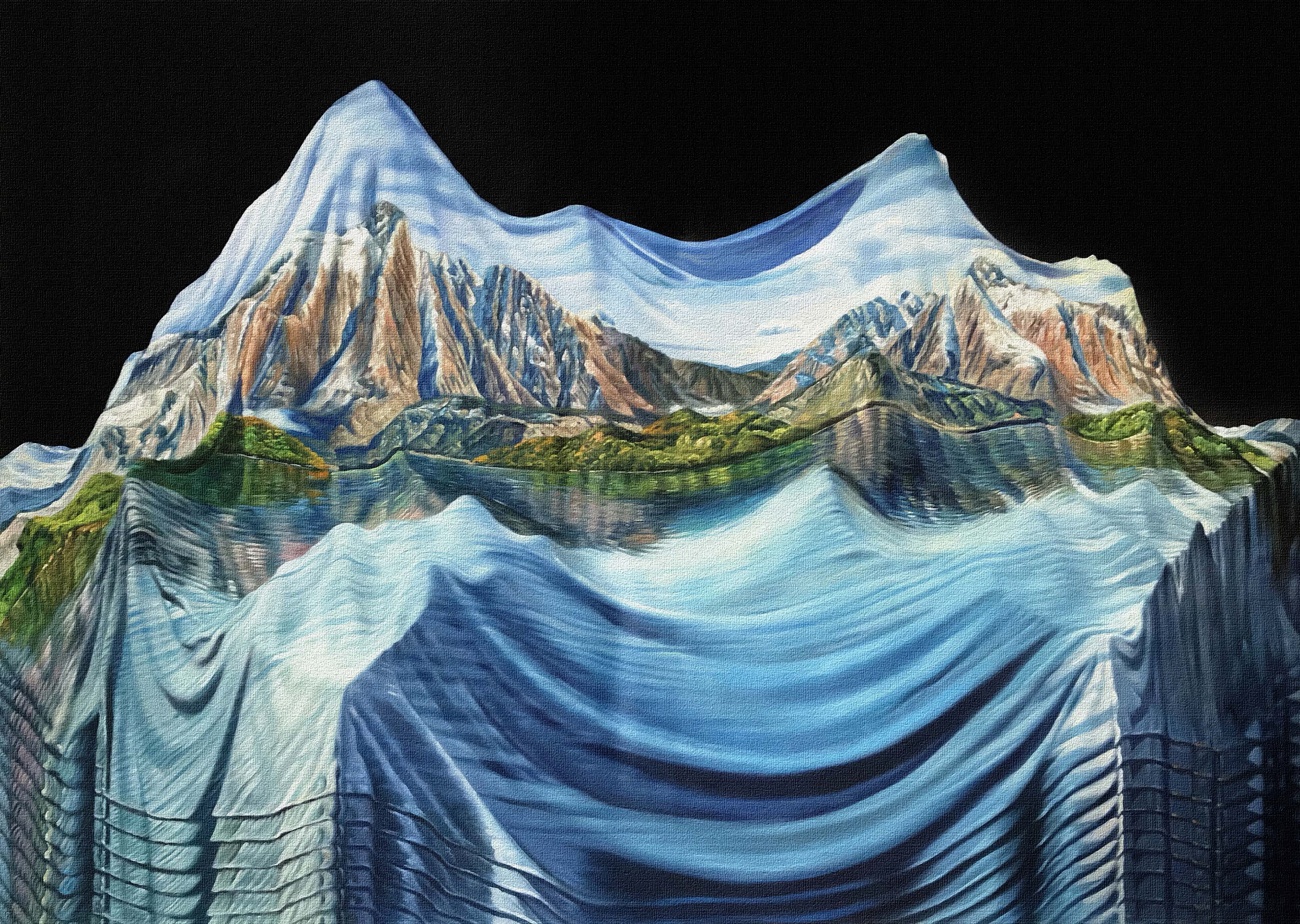
NF: I’d love to start with the wonderfully cryptic and captivating title of your series. What got you interested in the idea of ‘significance’ and semiotic structures of meaning?
A: The profound impact of literary structures became very much apparent to me during my theological studies. Though not immediately apparent, these structures illuminate the deeper dimensions of scriptural texts and unveil their nuanced layers, often allowing the corresponding parts to reveal non-explicit relationships between described objects, concepts, and themes. In a way, this series, as it is titled, acts as an existential juxtaposition, emblematic of life’s continual oscillation between moments of clarity, and periods of obscurity. Here, the dialogue between the explicit and implicit creates a liminal space that reflects the inherent duality of human experience — revealing the spaces where meaning is negotiated and re-negotiated — between certainty and doubt, knowing and unknowing, revelation and mystery.
“The intentional distortions rendered onto these landscapes are more than mere aesthetic choices; they are narratives.”
NF: It’s fascinating how you’ve transposed deep philosophical questions into paintings of the natural world. Why did you choose to focus on landscapes, and did enacting distortions upon them change your own relationship to nature?
A: Growing up, I was often swept up in mischief, and it was in the aftermath of such youthful missteps that my father, in his quiet wisdom, would suggest a day out at the beach. There, amidst the solitude of an idle weekday, we’d fish, swim, and eventually settle into the sand. While we gazed out at the horizon, he would often encourage me to reflect on my actions. He’s generally not much of a talker, so these conversations came few and far in between, and due to the nature of what inspired them, I was happy for this to be the case. Yet, this association between nature, contemplation, and paternal guidance, has profoundly influenced me — and to this day, the sight of a vast horizon is where I feel most connected to Source. It always makes me feel so small that all my worries just congruously dissipate into thin air.
I suppose it was a feeling I was seeking to capture in my paintings, that primordial ‘starting point’; an attempt to reclaim the pristine wildness of seas, mountains, and skies that exist in a state of delicate balance — simple in their complexity; whole in their simplicity. The intentional distortions rendered onto these landscapes are more than mere aesthetic choices; they are narratives. They chart the course of our thought processes and philosophies, which are not confined to sterile, controlled environments, but are instead part and parcel of our broader, messier human experiences — realities of suffering, joy, and the mundane. Essentially, it is through these altered visions of nature that I explore how our internal landscapes shape our interactions with the world around us.
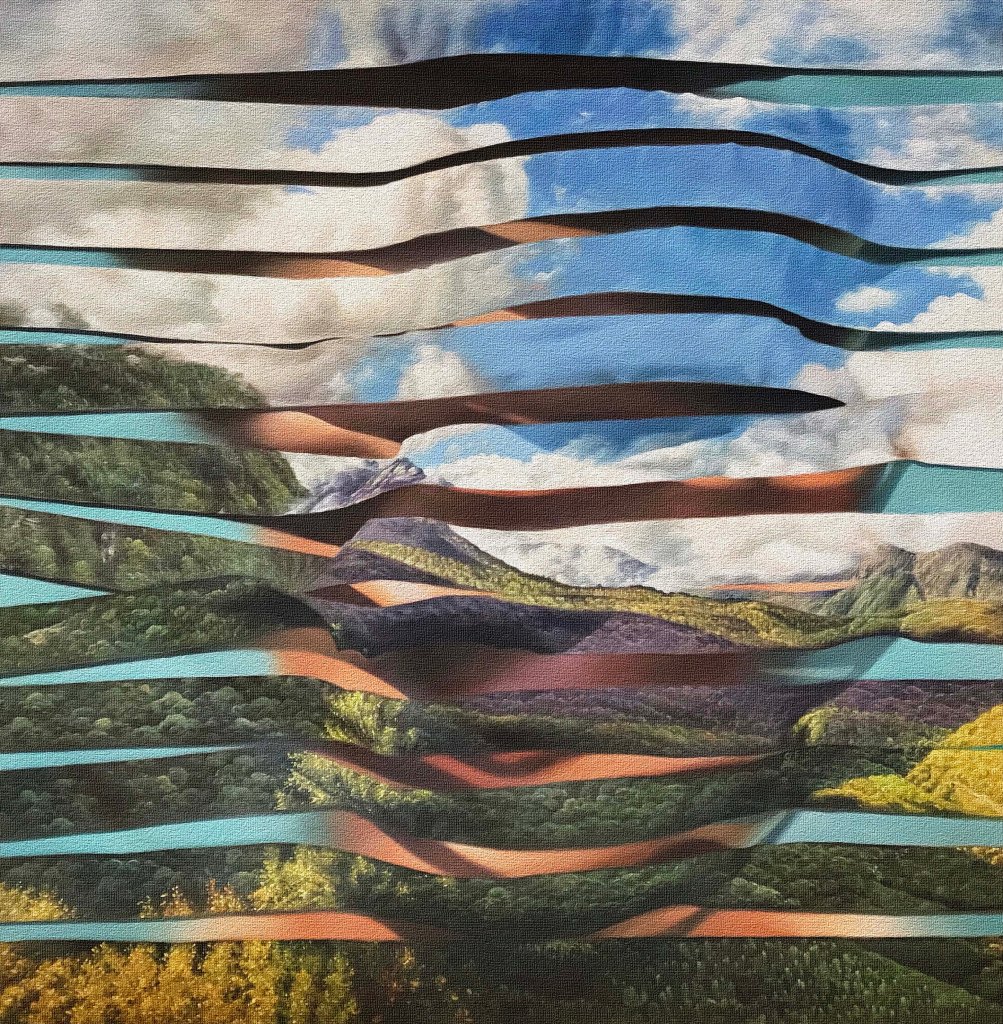
NF: It’s really interesting how the narratives of your landscapes pan out, because even as they’re revealed to be illusory, these vistas seem to maintain an insistent vitality — propping themselves up in #42514e and #4e6066, for instance, despite the dropping of the metaphorical cloth. As an artist who can conjure up such potent creations of the imagination, do you think illusions, for all their deceptive qualities, retain any substance?
A: Although it is often a term that carries implications of deception or a misconstrued sense of reality, the notion of illusion does not diminish the authenticity of our experience from a theological and philosophical vantage point. Rather, illusions can serve as indicators of a deeper reality that remains partially veiled from our current perception — and when interpreted with discernment, they guide us toward a more authentic engagement with the true nature of our being.
It’s akin to witnessing the natural world in its raw splendour while glimpsing its edges, its limitations, and its temporal nature. Does the awareness of its finitude take away from its beauty and grandeur? Does the recognition of the world’s temporality diminish our awe in the face of the boundless horizon where sea and sky converge, the undulating misty expanses of Pennsylvania’s rolling hills, or the majestic sweep of the Grand Canyon — its layers telling stories of eons past?
“In the painting’s ambition to capture the real, it inherently embraces the paradox of both illusion and reality.”
The awareness that we are witnessing a fleeting moment in the eternal narrative invites a deeper reverence for what lies before us and reminds us that we’re part of a larger story. Recognising this profound truth does not detract from the beauty of the ‘illusory’ surface; instead, it comes to coexist in dynamic tension with the fullness of reality, deepening our grasp of both the visible and the invisible.
Similarly, when it comes to figurative paintings, this illusory concept is particularly poignant. In the painting’s ambition to capture the real, it inherently embraces the paradox of both illusion and reality; every hue and shadow depicted represents both truth and fiction. I suppose in this instance, the work transcends being merely an assemblage of pigments and strokes; it becomes a vessel that carries the essence of something greater than itself. It embodies not only place and mood but also serves as a repository of meaning and interpretation, reflecting the perspectives of both the artist and the audience. In this context, the ‘illusion’ does not just retain its substance — how it interacts creates new meaning, and gives us a glimpse of the very essence that connects us.
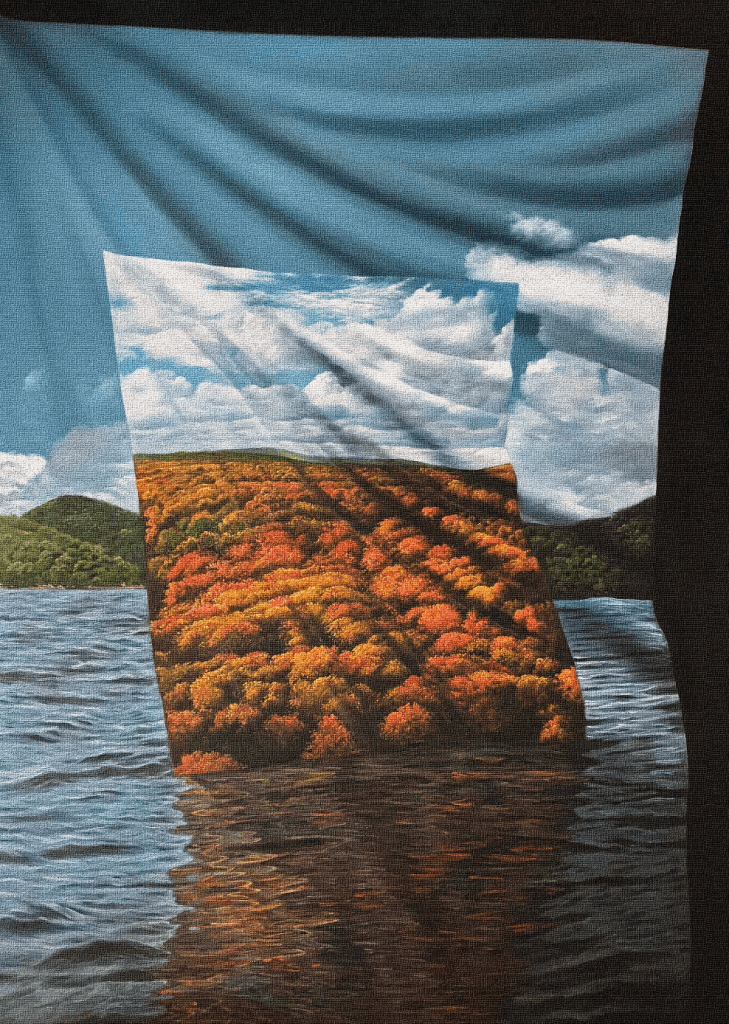
NF: In many of your works, you render surreal scenes with such photorealistic precision that their uncanny elements gain a heightened sense of clarity. I’d love to hear more about the development of your artistic style and whether it’s inflected by the development of your philosophical perspective. What draws you to figural representation for your experiments in form?
A: Throughout my practice, I have always been cognisant of the desire to explore topics that are authentic to my experience, and coincidentally enough, I often find that these themes intersect with the salient concerns of our times. As I navigate through topics such as sexuality, identity, and individuality, my expression of these facets often mirrors the egocentric and ethnocentric focus and understanding inherent in such explorations.
With time, as my philosophical and theological inquiries deepened, there emerged a shift in focus towards an understanding of the ‘whole person’. This perspective transcended the initial confines of self and culture, gesturing instead towards an omnicentric or cosmocentric vision of wholeness. Within this expanded frame of understanding, I have come to perceive nature not merely as an external entity but as intimately connected to the human experience — so much so that elements of nature can be seen as self-portraits or reflections of humanity.
One might argue against this reductionist perspective, advocating for the distinctions between humanity and nature, and with good reason. However, when simplified and stripped to the core, we are compelled to focus on the essential contrasts between physicality and spirit, form and formlessness, and the transient and the enduring. This, I suppose, can be likened to how literary structures guide readers to the focal point or central theme of a text, and in this case, to the art.
“It is the unknown, the formlessness that ultimately alters the form.”
NF: You’ve mentioned elsewhere that ‘the artworks examine the relationships — from both a syntagmatic and paradigmatic perspective — between the fall of one world, and another struggling to be born’. Could you expand on that, and tell us where you trace your interest in worlds beyond our own?
A: Within the context of a syntagmatic relationship, the portrayal of natural elements such as seas, land, mountains, and the sky collectively tell about existence, time, and place. Each of these carries with it a story of formation, evolution, and interconnection that speaks to the linear progression of time and the unfolding of creation itself. For instance, the seas can represent both life and chaos — a source of sustenance but also a force of untameable nature. One may view land as stability, fertility, and home; it is where human life unfolds and where the narrative of human history is written. Mountains are often depicted as places of encounter with the divine, spaces for revelation and transformation. And the sky: a canvas of the heavens, a vault that inspires wonder and speaks of the transcendent.
Paradigmatic relationships, on the other hand, represent the vertical dimension of existence — the deeper truths, values, or beliefs that may interchangeably inform our understanding of the physical realm. This is less about the linear progression of events and more about the underlying patterns or archetypes that shape our perception of reality. In the context of this series, it is the unknown, the formlessness that ultimately alters the form.
“The enduring interplay between simplicity and complexity — culminating in a sense of wholeness — points to a deeper coherence.”
When we consider how one dimension affects the other, the syntagmatic sequence of our physical lives is infused with meaning through the paradigmatic lens of spiritual beliefs. For instance, the concept of Imago Dei — the belief that every individual reflects God’s image — encourages a reverence for life that transcends mere physicality. It encourages us to view each human encounter and experience as significant, not merely as fleeting moments but as opportunities to honour the divine presence within and among us.
How this is represented in this series is as a threshold, a meeting place of the temporal and the eternal, the seen and the unseen, the syntagmatic and the paradigmatic. It is an invitation to dwell in that tension, to see beyond the ‘edges’ — the limits of our immediate perception — and to discern the ‘essence’ — the underlying eternal truth that animates all of creation.
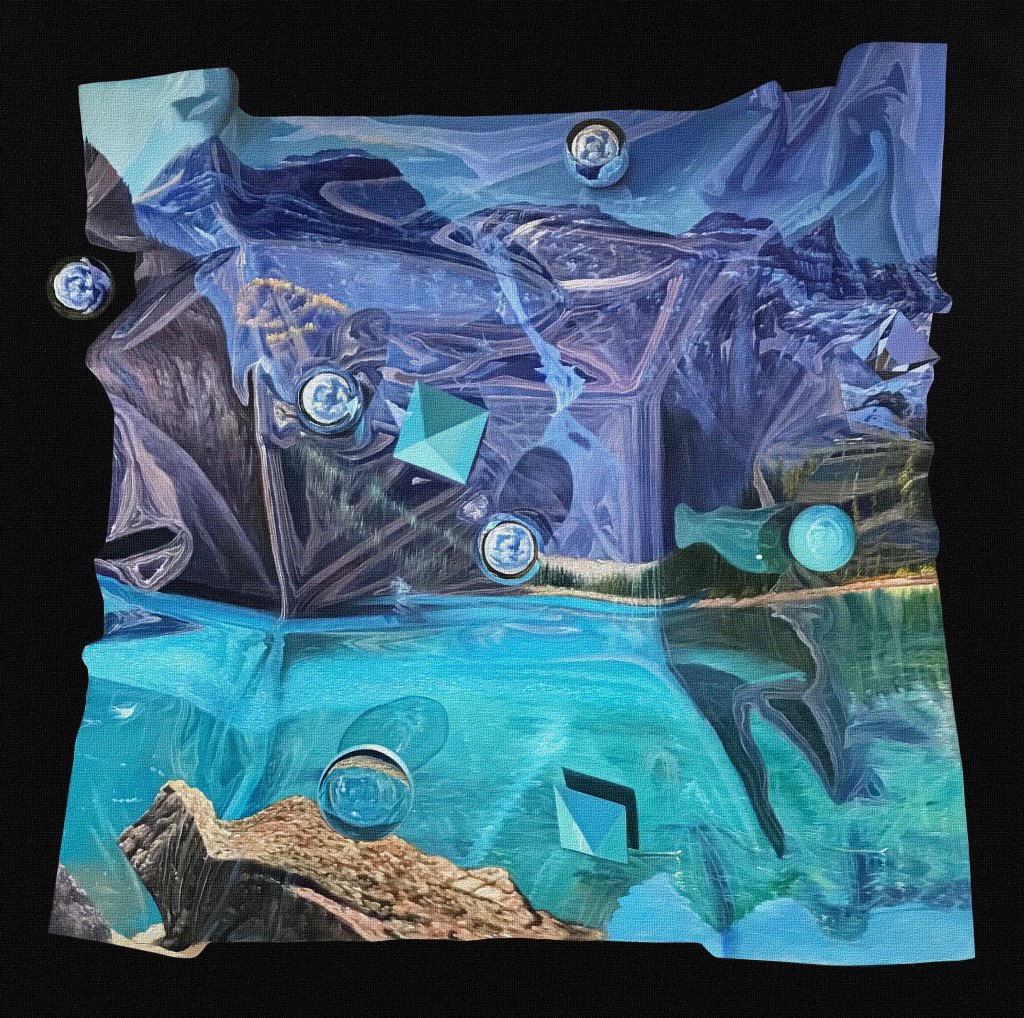
NF: Speaking of going beyond the edges, what role does ambiguity play in your creative and intellectual practice? Your work seems to embrace the formless without trepidation — I’m thinking especially of #2e3a42 and #323434, for example, where dynamic elements enliven the distortions with a sense of playfulness and vibrancy. How do you face the unknown?
A: The maturation of the human spirit often unfolds from a journey that begins with self-centred awareness, gradually expanding outward — from egocentric to ethnocentric, then to world-centric, and ultimately toward an omnicentric worldview. Yet, philosophical and spiritual traditions across the ages hint at a further evolution of consciousness: a transcendence beyond even the omnicentric, where one seeks to encounter and comprehend realities that surpass the tangible universe. This is the threshold of spiritual consciousness, a realm where the apprehension of reality is not limited to physical senses or intellect.
In creating these two works, I did contemplate on how to best articulate this awareness. The initial step, as I perceive it, is recognition — acknowledging this journey toward a formless unknown activates a transformation of perception, awakening our innate sense of wonder. Yet, acknowledgment begs the question: what comes next? How do we begin to unravel this complexity? Might we adopt the methodical learning approach of a child, mastering simplicity before attempting to grasp the grandeur of the whole?
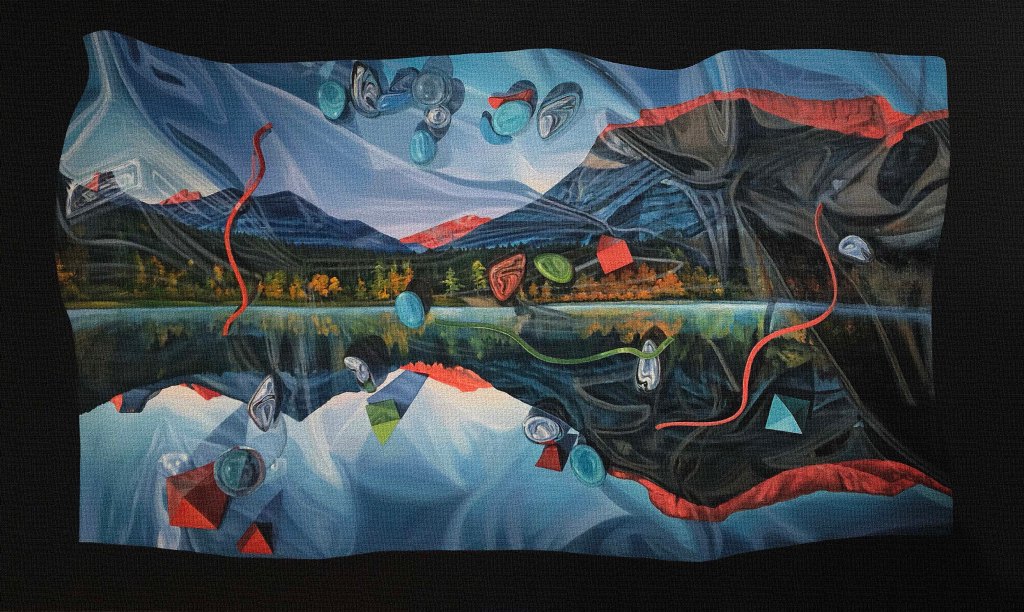
As articulated in the paintings, even in its rudimentary forms — of spheres, pyramids, lines and scribbles — some of these shapes bear a reflective quality, being mirrors not just of the landscapes depicted but also of the immeasurable unknown that surrounds them. These reflections are deliberately inclusive, drawing into their scope all that dwells within their periphery. Here, we return again to the paradox that simplicity can encompass complexity, and that within such complexity lies an inherent wholeness. For me, this enduring interplay between simplicity and complexity — culminating in a sense of wholeness — points to a deeper coherence, which I find quite comforting.
“I think of beauty not as an intrinsic quality of things, but rather a state of perception.”
NF: Your depth of thought and sensitivity really highlights just how attuned you are to the intricacies of existence — and so, finally, I’d love to know: what does beauty mean to you, and how do you appreciate it in your life?
A: I think of beauty not as an intrinsic quality of things but rather a state of perception, an experience that emerges from a certain alignment with love and harmony. It is not merely aesthetic, but a dynamic encounter that resonates with the deepest levels of human understanding. This conception of beauty does not negate or dismiss the presence of suffering, sadness, or the imperative for action. Rather, it acknowledges a profound awareness of the interconnectedness of our very human experiences — of joy and sorrow, revelation and mystery, suffering and redemption.
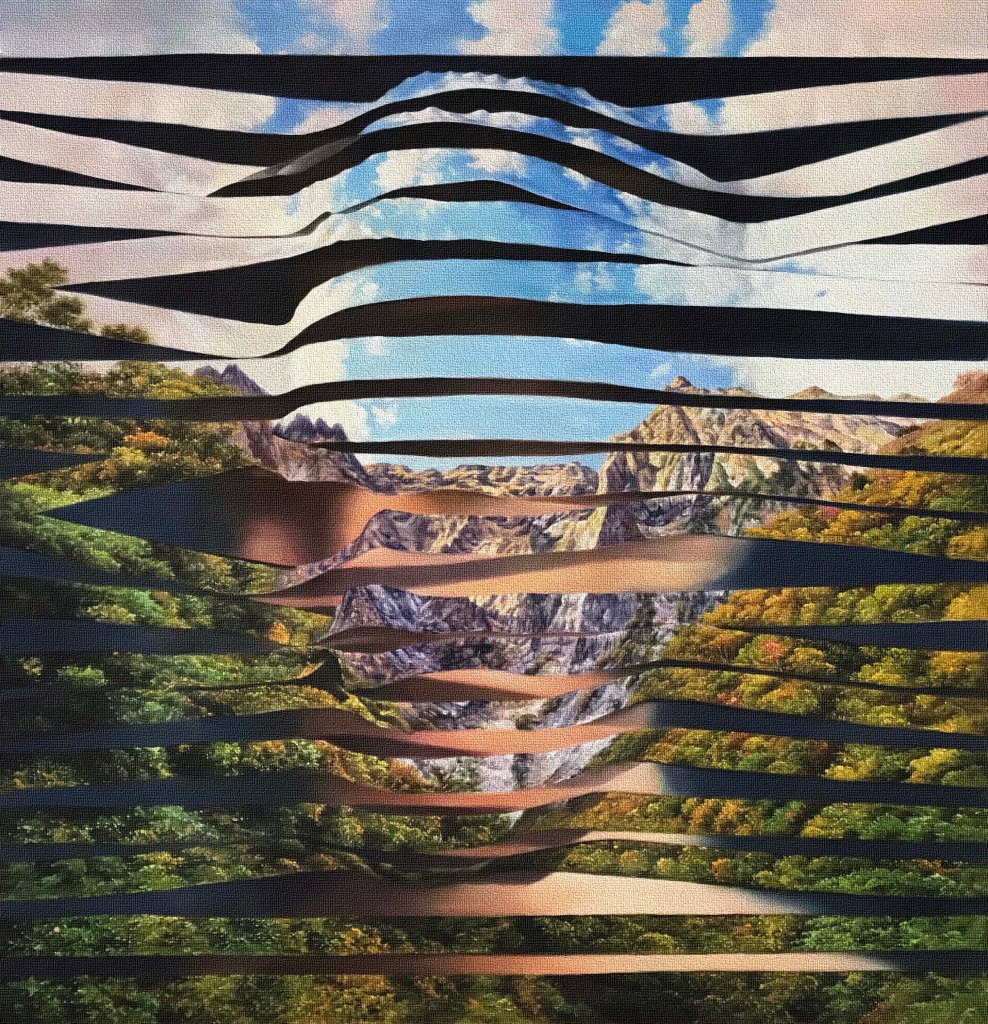
Represented by Art Porters Gallery, Aiman’s new artworks — an extension of his explorations from his previous exhibition, ‘The Significance of it All is the Insignificance of it All’—will be featured in the S.E.A Focus 2024 showcase, taking place from January 20th to 28th, 2024. Curated by John Tung, ‘Serial and Massively Parallel’ presents a curated assembly of regional artworks, each offering profound insights into our intrinsic human identity amidst an impending technological confluence.
PROSE / ERIN ROWLINSON-MARTIN
I left my name at the start
I left my name at the start like a bag and coat at a party. Found it among the others weeks later, stretched its meaning stiff over my head once more.
Each day was a lovely one, but a loveliness all serrated now. We had warmed our cheeks on the flat edge with palms planted firmly in the earth. In the sun without titles we disappeared, conversing in one continuous note, the spike of naming gone from under each tongue.
When the sun left we spread ourselves across garden and patio, bashfully. The evenings needed pulling to a close.
In the end the big hand found us. Nudging each finger open with my head I crawled inside its fist, its drawing lining rotating wrist.
Here we are in choreography, this chronology, pared jagged from the sediment range just to the left. Here I am in the sunroom, the sun going through me a little less.
POETRY /
PETER LILLY
Evidence
The price of help here is beyond,
It speaks in the emotional
Language of your marrow,
Presuming its own necessity
It requires a fragment
Of every single thing.

The answer is to ask
For nothing.
Be the counterfactual,
The living evidence of the conspiracy theory.
Bring the past and the future
Into the collision of the present
And draw attention to its
Perpetual explosion.
III.
Fractures
POETRY / ULRICA HUME
Warrior Clouds
I.
To be no one,
anyone, in this ancient place, where
clouds as rampant dream-ships
pass as powerful as gods.
In the sky I see a sly path forming,
a trap door opening to
the brief levitations of fate.
Some see the ascending spiral,
others don’t. I know that you
do. In stillness I wait
for grief to find
the various
and impossible
mutations of joy.

II.
What did he see? Winged backs
turned, ever watching him? Their eyes
as one black depthless flicker,
looking back —
the ember of their talk
reminding him
what was,
and what by passion
always lost.

III.
She says she has the heart
of a chameleon
its colours bright but
changing. She says there is
no cure for this,
no urban elixir that will
miraculously cleanse her need
for truth, or her love
of deception.

IV.
What, this diamond, and what,
this mud? Sometimes, in the waning
dusk, or in the light unmasked
by dawn, even the cynical lover
gets it wrong — sees birds flying
right to left, reversed,
when they should be going
the other way; hears tricksters
speak his given name,
when only angels
frail and bright,
are meant
to know him.

V.
Fragments, these,
poor cracked clay pots,
letting out water
spilling upon the faintest
scrawls these hieroglyphics
of the soul.
FILM / PATRYCJA LORANC
Fragments of Experience
Find out more about the project and watch the full series here.
POETRY / EMILY LIU
self-portrait as fabrics
my pastel
shirts breezing
from a laundry
line.
jasmine chill
fluttering garden
fill out fabric
with phantoms
like breath—
how each
settled over
skin.
that one the pink
wanting to feel
a princess
in the absence
of you.
green to match
the cloudy
pacific.
and yes
that one gentle orange
for the halo
of street lamps
at dusk
when glasses turn immaterial.
hook them
from collar
lift face —
hello
vast expanse
hello
blurring world.
i return
to mere outline
of a life before
shaded
and
worn.
VISUAL ART / ABI HUBBARD
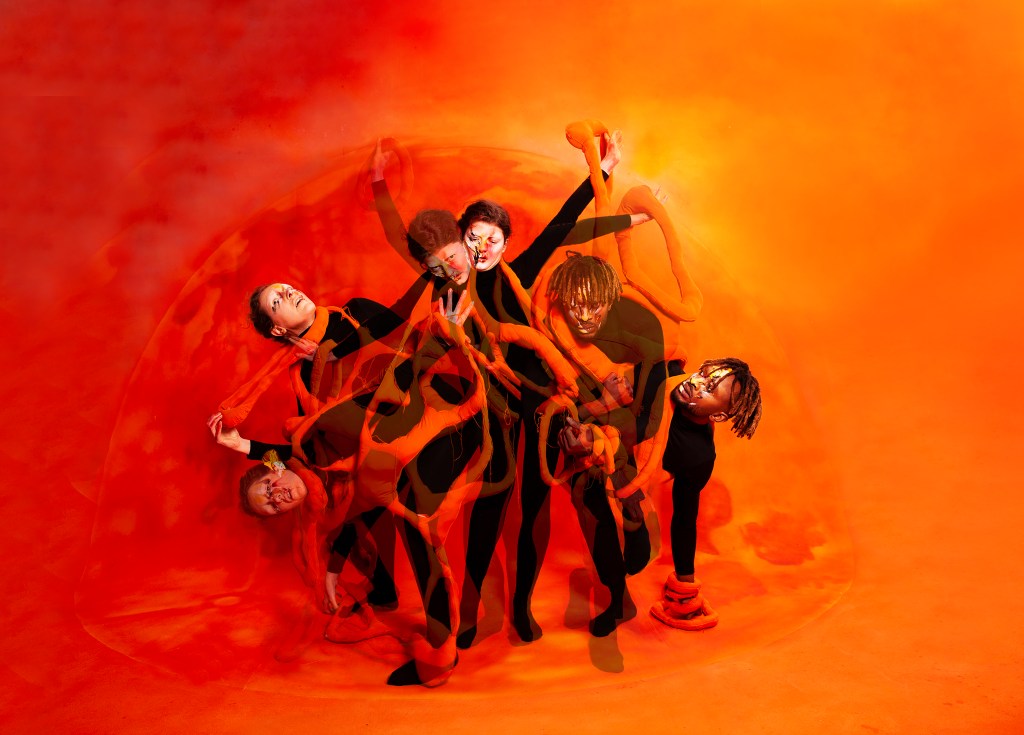
Polyester Paganism
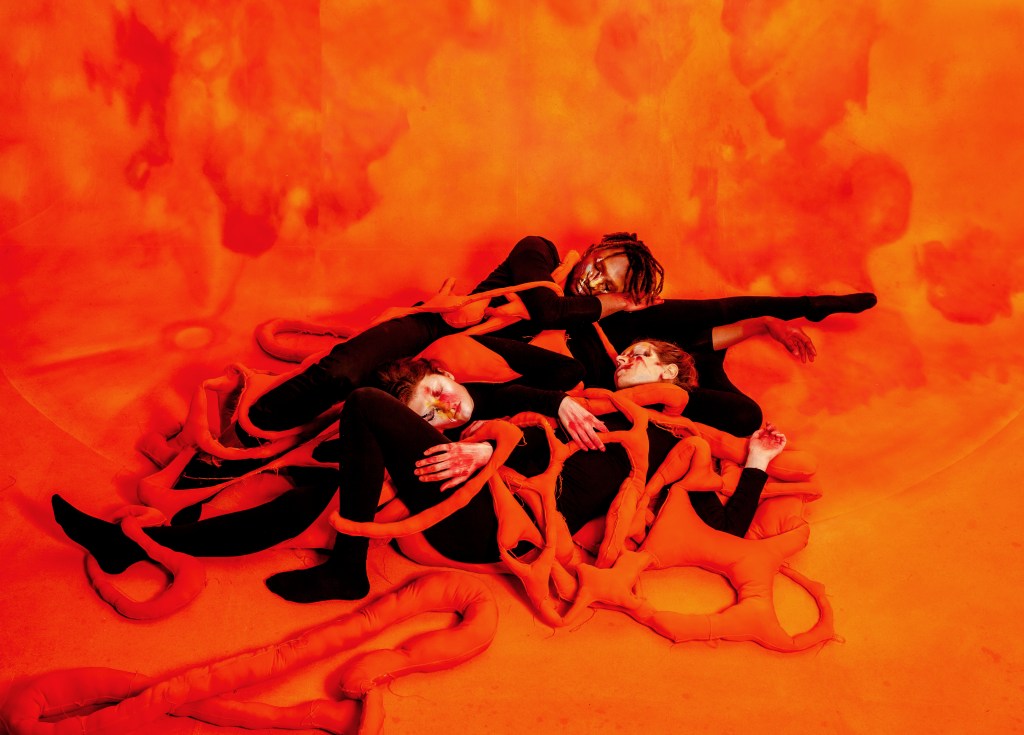
Polyester Paganism was inspired by slime mould and how it reflects the queer community with its beautiful, alien, and transformative properties. Celebrating the joy of difference and discovery, the series intends to rewrite binaries within pagan traditions, creating a new language that negates human exceptionalism and champions the absurd, unknown, messy, maverick future world.
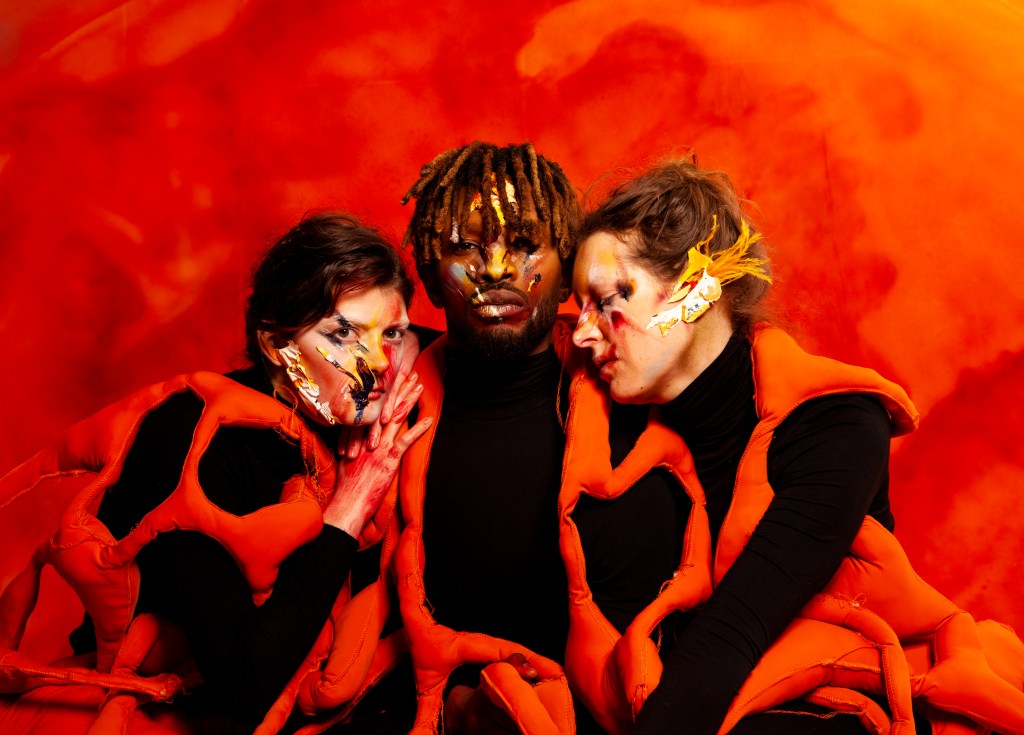
As our systems fail and break down,
what will map our exodus?
POETRY / REZYL GRACE
Flight
The wingbeat
is what fascinates about angels
and birds — the carving
of time and space
together in a single
motion, as though
the feathers hide
a glimpse of un-
observed light.

The closest thing
a human has
is the blink of an eye —
a sweep of the lid
through moments of arc,
like a Renaissance planet
in the hands of an angel
with face turned
from the sun.

This, perhaps,
is the difference in being
made but a little
lower: that,
if you wish to see things
as they truly are,
you must draw yourself
so very close
to death and then swerve.
Our Contributors
Abi Hubbard is an internationally exhibiting artist originally from Norfolk, UK. She studied her Bachelor of Arts (Fine Art) at Nottingham Trent University and in 2019 received a Masters from The Royal Welsh College of Music and Drama. After graduating she was awarded a Create grant from the arts council of Wales to produce the Polyester Paganism series, resulting in a solo show at D Unit gallery and Tactile Bosch. Other recent exhibitions include Agora, Promenade and The May Day show.
–
An interdisciplinary artist and fine arts alumnus of Lasalle College of The Arts, Aiman’s practice has journeyed exhibitions and art fairs from the local stages of Singapore to international platforms in Malaysia, Indonesia, China and the US. Having held three solo exhibitions, he was also profiled alongside ten artists from South East Asia in 2020, in collaboration with ArtSEA on establishing arts-based initiatives for social impact. His current practice — deeply informed by his ongoing studies in Theology at the University of Divinity (AU) — seeks to engage with and dissect philosophical questions within the context of contemporary discourse.
–
Archana Dineshkumar Manhachery is an Indian poet, junior science editor and counselling psychologist hailing from a small town in Kerala and presently residing in Hyderabad. Her poetry has appeared in Spiritus Mundi Review and is soon to be published in Black Bough Poetry. She posts on X (formerly Twitter) as @archiusmoon.
–
Darcy Smith’s debut collection, River Skin, Fernwood Press 2022, was a semifinalist for the Hillary Gravendyk Prize. Recent poems appear in Please See Me, Medmic, and Songs of Eretz Poetry Review. Awards include the Please See Me Mental Health Poetry Prize and the Medmic Poetry Prize. She is a Certified ASL Interpreter, Buddhist, kickboxer, wife & mother. Smith lives with her husband & their cat, Miley in New York’s Hudson Valley. Learn more at: www.darcysmith.org.
–
Emily O Liu is a second-generation Chinese American writer from San Diego, California. A former Fulbrighter teaching English in Taiwan, she is currently studying education at Stanford University. Her work appears or is forthcoming in No Tokens, Lost Balloon, The Gravity of the Thing, HAD, Gone Lawn, and other places. She is interested in languages, multiverses, windows, and any of their combinations.
–
Erin Rowlinson-Martin (she/her) writes and walks around in Newcastle Upon Tyne. She often finds herself writing about things like cities, spaces, language, fruit, foliage and memories of warmth. A recent Fine Art graduate from Newcastle University, she has just completed a summer residency at The British School at Rome.
–
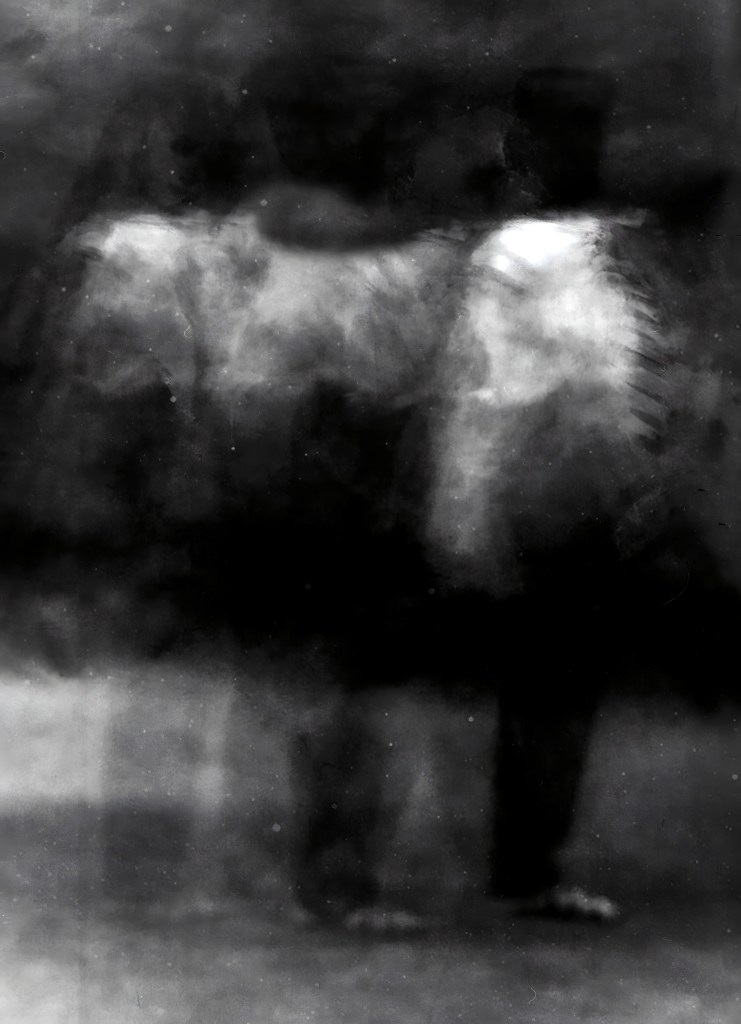
Liliana Del Vedova, a multidisciplinary artist with Indigenous and Spanish roots, graduated from The School of Photographic Arts, earning the Solstice and Integrity of Vision Award. Passionate about exploring human nature and spirituality, her art delves into profound questions, fearlessly combining historical techniques with modern experimentation. Liliana’s creative process involves large format cameras, chemigrams, gold leaf, sound, and crystal growth, skillfully incorporating imperfections to highlight the complexity of human experience. Currently immersed in an Ottawa residency spanning from June 2023 to December 2023, she is dedicated to her project, (( Otherwordly )), supported by The Canada Council for the Arts, and is set for both exhibition and a book release in 2024.
–
Mikkel Rohde Skovlunde (he/him, b. 1995) is a Danish visual artist living and working in Copenhagen, Denmark. Skovlunde is intrigued by the apparent mystical scenarios surrounding us daily: the phenomenology of object and space, time and being as well as the perception of experienced reality. It is the attentiveness to carefully select, arrange and manipulate objects and images that, somewhat therapeutically, reminds him of ancient ceremonies or rites of rituals. He often finds his work originating from a deeply solitary, at times spiritual place, as a sort of healing instrument for any advancing existentialism.
–
Nicholas Rooney grew up in Liverpool and currently lives in South-East London. He started writing poetry as a teenager and hasn’t got round to stopping yet. His work has previously been published in On Hunger: A Poetrygram Anthology edited by Helen Cox and Poetry’s Not Dead: The Brian Dempsey Memorial Competition Anthology 2023 edited by Janice Dempsey. For the latest information on Nicholas’s work, please visit: nicholas-rooney-poetry.co.uk.
–
Patrycja Loranc is an experimental filmmaker, artist, and PhD researcher at University of Plymouth. Working with moving image, sound, photography and writing, she is developing a Psychepoetic Film Practice, exploring filmmaking as a tool for psyche-revealing. Using her own experiences of autistic sensory sensitivities, she creates works around complexities of perception in intervening spaces between inner and outer, testing boundaries of what’s considered real. Absorption, an altered state of consciousness, is a method and a point of focus. She works as a freelance editor, associate lecturer, arts administrator, festival pre-selector, and is the co-founder of Alternative Night of Experimental Film.
–
Peter Lilly is a British Poet who grew up in Gloucester before spending eight years in London studying theology and working with the homeless. He now lives in the South of France with his wife and son, where he concentrates on writing, teaching English, and community building. His debut collection, ‘An Array of Vapour’, is forthcoming with TSL publications, and his second collection, ‘A Handful of Prayers’, is forthcoming with Wipf & Stock.
–
Reyzl Grace is a poet, essayist, translator, short story writer, and post-Soviet Jewish lesbian from Alaska. Her work has been nominated for the Pushcart Prize, named a finalist for the Jewish Women’s Poetry Prize and Best Literary Translations, and been featured in Room, Rust & Moth, the Times of Israel, and elsewhere. By day, she is a teen services librarian in Minneapolis — by night, a poetry editor for Psaltery & Lyre and Cordella Magazine. You can find more of her at reyzlgrace.com and on Twitter/Bluesky @reyzlgrace.
–
Ulrica Hume writes at the intersection of women’s issues and spirituality. She is the author of An Uncertain Age, a novel, and House of Miracles, a collection of stories, one of which was selected by PEN and broadcast on NPR. Her flash pieces appear online (Short Édition, Litro, EcoTheo Review, etc.), in literary journals (Chicago Quarterly Review, Firmament), and in anthologies. She tweets @uhume.
–
Image Credits: Backgrounds and graphics are adapted from open-source images on Unsplash.
Our Editors
Nicole Fan is a multidisciplinary creative with a love for storytelling and a range of eclectic interests. Having graduated with a Master’s from the University of Oxford and a BA from UCL, she now works in editorial and digital content within the creative industry. Find out more and get in touch at nicole-fan.super.site.
Jessica Peng lives and writes in London. In 2022 she graduated from UCL with an English degree and took a job in the arts. She writes about culture and other mundanities on her Substack and edits poetry at The Primer.
fin.
2023 The Primer © All Rights Reserved
Unauthorised use and/or duplication of this material and design without express and written permission from this site’s author and/or owner is strictly prohibited. Excerpts and links may be used, provided that full and clear credit is given to the creator and The Primer with appropriate and specific direction to the original content.
 The Primer